What About Winning % for NFL Teams?

Most of our previous articles dealt with winning percentage as it relates to city misery. Our last article began our series on winning percentage as it relates to team misery for the MLB. This article will continue our exploration of the five- and ten-year winning percentages as it relates to team misery, but will focus on the NFL.

Table A provides the average winning percentage for each NFL team over the past five years (2019-2023) and ten years (2014-2023). The teams are listed in descending order according to their winning percentage. So, in terms of fan misery, the further down the list equates to higher levels of misery.

NFL Team5-year Average Winning %Std. Dev.NFL Team10-year Average Winning %Std. Dev.
Kansas City.7602.09Kansas City.7182.22
Buffalo.7091.68New England.6361.39
Green Bay.6781.43Pittsburgh.6331.37
Baltimore.6771.42Green Bay.6241.27
San Francisco 49’ers.6491.20Seattle.6131.16
New Orleans.6070.85Baltimore.6011.04
Dallas.5990.79Dallas.5991.03
Pittsburgh.5850.68Buffalo.5981.02
Seattle.5820.65New Orleans.5850.88
Tampa Bay.5780.63Philadelphia.5720.75
Philadelphia.5690.55Minnesota.5680.71
Los Angeles Rams.5550.44Los Angeles Rams.5660.69
Tennessee.5440.35Indianapolis.5010.03
Minnesota.5420.34Los Angeles Chargers.496-0.01
Miami.5290.23Miami.496-0.02
Cleveland.5190.15Cincinnati.490-0.08
New England.496-0.03San Francisco 49’ers.481-0.17
Indianapolis.490-0.08Las Vegas.478-0.20
Las Vegas Raiders.478-0.18Tennessee.472-0.26
Cincinnati.455-0.37Denver.468-0.30
Oakland Raiders.438-0.50Arizona.462-0.36
Los Angeles Chargers.432-0.54Detroit.460-0.38
Detroit.395-0.85Tampa Bay.458-0.40
Arizona.392-0.87Atlanta.455-0.43
Chicago.388-0.90Houston.453-0.45
Denver.386-0.92Charlotte.436-0.63
Atlanta.385-0.93Oakland Raiders.407-0.92
Houston.381-0.96St. Louis Rams.407-0.92
Washington.355-1.17Washington.399-1.00
New York Giants.354-1.17Chicago.388-1.11
Jacksonville.334-1.33Cleveland.375-1.24
New York Jets.324-1.41New York Giants.371-1.28
Charlotte.290-1.69New York Jets.337-1.62
   Jacksonville.330-1.70

Table A: Average winning % over the past five and ten years1

As is our practice, we like to have the data tell the story. First, let’s once again begin with a general observation regarding the nature of statistics. We have discussed in previous articles that in situations in which outcomes are roughly 50/502, as you increase the number of observations, the variability of the outcomes will reduce. Similarly to the situation with MLB teams, this is easily seen in the NFL data with the difference between the highest and lowest winning percentages for five years (.470) versus that for ten years (.388). In addition, we see the highest winning percentage for five years being .042 higher and the lowest winning percentage for five years being .040 lower than those for ten years. So, over the long haul, the winning percentages for all teams should move toward .500.3

Second, there are several NFL teams that have provided their fans with dreadfully low winning percentages over the past ten years. This may be particularly painful for NFL fans as you usually have to live with your misery for an entire week before you have a chance at rehabilitation. These teams include Jacksonville, both New York teams, Chicago, and Washington. Cleveland provided plenty of misery over the past ten years as well, but their most recent five-year improvement indicates that their fans had really high misery from 2014-2018. This suggests an alternative way to assess NFL team misery in terms of team winning percentage.

YearsNFL Team5-year Average Winning %Std. Dev.
2012-2016Jacksonville.213-2.31
2013-2017Cleveland.188-2.51
2014-2018Cleveland.232-2.16
2015-2019Cleveland.219-2.26
2016-2020New York Jets.288-1.71
2017-2021New York Jets.272-1.83
2018-2022Jacksonville.291-1.68
2019-2023Charlotte.290-1.69

Table B: NFL team with the lowest average winning % over the listed five years

Table B provides the NFL team with the lowest average five-year average winning % for the years listed in the table. Beginning in 2012, Cleveland’s .188 winning percentage over the five seasons from 2014-2018 is the only five-year winning percentage under .200 for any sports team in any of the four major sports. Jacksonville’s five-year winning percentage of .213 from 2012-2016 is the only one that even rivals the three successive five-year runs for Cleveland beginning in 2013. This certainly lends credence to the notion that Cleveland Browns fans can lay claim to the most miserable five-year stretches when compared to any other NFL fan base. But what if we consider a more extended notion of misery. Jacksonville has the lowest ten-year winning percentage, but it is not much below that of the New York Jets. After that, it is a bit of a jump to the third worst team—the New York Giants. Jaguar and Jet fans have truly had a brutal ten-year stretch, but is one worse off than the other? What is revealed if we look at their records in a slightly different way?

NFL TeamTimes in Bottom Five
Jacksonville8
New York Jets6
Cleveland5
New York Giants5
Tampa Bay3
Chicago2
Cincinnati2
Detroit2
Oakland2
San Francisco2
Tennessee2
Charlotte1
Las Vegas1
Washington1

Table C: Beginning in 2012, the number of times an NFL team has been one of the lowest five in terms of five-year winning %

Table C provides information about the five-year winning percentage beginning with the years 2012-2016 and ending with the years 2019-2023. This provides eight different five-year scenarios. With that being said, one can see that Jacksonville’s average five-year winning percentage has been one of the five lowest in each of those eight scenarios. Not surprisingly, the New York Jets have been among the lowest five teams on six different occasions. Based on the winning percentages over the past two seasons, Jacksonville fans seem to have some reason for hope.4 Unfortunately, Jets’ fans misery seems to continue unabated, especially when a certain Achilles tendon ruptured a few plays into the 2023 season.

So, in terms of winning percentages, it seems as though Cleveland Browns fans can lay claim to the most miserable 5-year stretch that any sports fan has had to endure. On the other hand, both Jacksonville and the New York Jets have been dishing out almost as much misery, but over a longer period of time. However you slice it, these football fans need the same hug as the one needed by Detroit city fans.

_______________________________________________________

1 Due to the movement of teams to a different city over the past ten years—St. Louis Rams to Los Angeles, Oakland Raiders to Las Vegas, and San Diego Chargers to Los Angeles—there is an unequal number of teams with data for the last five years versus that of ten years.

2 This assumes that either (a) each event (game) is a 50/50 proposition, or (b) recent “good” teams will fall upon hard times in the future as often as recent “bad” teams will rise above their current station. New England is a prime example of the first phenomenon while Cleveland is probably the best example of the opposite phenomenon.

3 In looking at Table A, note that the top six 5-year winning percentage teams all have lower 10-year winning percentages. Also note that ten out of the bottom eleven 5-year winning percentage teams all have higher 10-year winning percentages (the exception is Jacksonville).

4 Jacksonville had winning percentages of .529 and .529 in 2022 and 2023, respectively. The New York Jets had winning percentages of .412 and .346 in 2022 and 2023, respectively.
What About Winning % for MLB Teams?

“Tis better to have loved and lost than never to have loved at all.” Detroit Lions fans have the entire off-season to decide whether that is true or not. However, for baseball fans, pitchers and catchers arrive at spring training in the next few weeks.

Previous articles have focused on winning percentage as it relates to city misery. This article will begin our exploration on the five- and ten-year winning percentages as it relates to team misery. While this article will focus on MLB teams, future articles will concentrate on NFL, NBA, and NHL teams, respectively.

Table A provides the average winning percentage for each MLB team over the past five years (2019-2023) and ten years (2014-2023). The teams are listed in descending order according to their winning percentage. So, in terms of fan misery, the further down the list equates to higher levels of misery.

MLB Team5-year Average Winning %Std. Dev.MLB Team10-year Average Winning %Std. Dev.
Los Angeles Dodgers.6653.01Los Angeles Dodgers.6243.02
Tampa Bay.6041.89Houston.5681.65
Atlanta.5991.80New York Yankees.5631.52
Houston.5881.60Cleveland.5491.20
New York Yankees.5741.35Tampa Bay.5461.11
Milwaukee.5430.79St. Louis.5410.99
Minnesota.5380.70Chicago Cubs.5330.81
Cleveland.5380.68Atlanta.5320.77
St. Louis.5290.54Milwaukee.5210.52
Toronto.5250.46Boston.5180.44
San Francisco Giants.5210.39Toronto.5180.44
San Diego.5180.34Seattle.5090.22
Philadelphia.5130.24San Francisco Giants.5050.12
New York Mets.5050.09New York Mets.5010.03
Seattle.5050.09Minnesota.5010.01
Chicago Cubs.499-0.03Washington.498-0.04
Chicago White Sox.496-0.07Oakland Athletics.486-0.34
Boston.490-0.19Los Angeles Angels.483-0.41
Oakland Athletics.482-0.33San Diego.479-0.51
Cincinnati.476-0.43Philadelphia.475-0.62
Los Angeles Angels.451-0.90Chicago White Sox.468-0.78
Arizona.448-0.95Texas.463-0.89
Miami.446-0.99Arizona.463-0.90
Baltimore.441-1.07Baltimore.460-0.97
Texas.439-1.11Pittsburgh.458-1.03
Washington.437-1.14Colorado.450-1.21
Colorado.423-1.40Cincinnati.450-1.22
Detroit.410-1.63Miami.450-1.22
Kansas City.400-1.82Kansas City.449-1.24
Pittsburgh.394-1.92Detroit.439-1.48

Table A: Average winning % over the past five and ten years

As is our practice, we like to have the data tell the story. First, a general observation regarding the nature of statistics. We have discussed in previous articles that in situations in which outcomes are roughly 50/501, as you increase the number of observations, the variability of the outcomes will reduce. This is easily seen in the difference between the highest and lowest winning percentages for five years (.271) versus that for ten years (.185). In addition, we see the highest winning percentage for five years being .041 higher and the lowest winning percentage for five years being .045 lower than those for ten years. So, over the long haul, the winning percentages for all teams should move toward .500.2

Second, although this website is primarily devoted to the misery experienced by sports fans for cities and specific teams, it is very difficult to overlook the extraordinary winning percentages for the Los Angeles Dodgers over both the five and ten-year horizons. We have only provided a little background on the statistic known as standard deviation, but enough to realize that a standard deviation greater than +3 or less than -3 has a probability 3/1000. A closer look at Table A reveals that the Los Angeles Dodgers have had a winning percentage greater than +3 standard deviations for both their most recent five and ten-year time horizons. The cynical fan may suggest that the Dodgers consistently have one of the highest MLB payrolls, but one must recognize that the large sums of money have been strategically well spent when it comes to winning regular season games. In fact, let’s take a closer look at this last statement to see how “strategic” the Dodgers have been in relation to the rest of the league when it comes to spending money on their payroll.

We will define a concept called strategic dollar use (SDU). SDU is a relative measure that tries to provide some insight into how well the money you spend in payroll dollars translates to regular season winning percentage. In order to accomplish this, we will compare the standard deviation for winning percentages with the standard deviation for payroll expenditures for each specific team. SDU will be the difference between these two statistics. The notion is that a higher SDU equates to a more effective use of payroll dollars. Table B provides the SDU for each team over the past five years and Table C provides the SDU for each team over the past ten years.

MLB Team5-year Average Winning %Std. Dev.5-year Average Payroll (million)Std. Dev.SDU
Tampa Bay.6041.8956-1.383.27
Cleveland.5380.6864-1.201.88
Atlanta.5991.801370.441.36
Milwaukee.5430.7996-0.491.28
Los Angeles Dodgers.6653.011981.791.22
Oakland Athletics.482-0.3356-1.391.06
Minnesota.5380.70107-0.240.94
Houston.5881.601520.760.84
Seattle.5050.0995-0.510.60
Baltimore.441-1.0748-1.570.50
Miami.446-0.9960-1.300.31
Toronto.5250.461250.160.30
St. Louis.5290.541320.330.21
Cincinnati.476-0.4397-0.470.04
San Francisco Giants.5210.391390.48-0.09 
Chicago White Sox.496-0.071260.18-0.25
Arizona.448-0.9590-0.62-0.33
Pittsburgh.394-1.9247-1.59-0.33
San Diego.5180.341520.77-0.43
New York Yankees.5741.352031.92-0.57
Chicago Cubs.499-0.031490.69-0.72
Kansas City.400-1.8274-0.98-0.84
Philadelphia.5130.241691.15-0.91
Detroit.410-1.6389-0.64-0.99
Texas.439-1.11115-0.07-1.04
Washington.437-1.14117-0.01-1.13
Boston.490-0.191681.12-1.31
Colorado.423-1.401210.07-1.47
New York Mets.5050.091951.74-1.65
Los Angeles Angels.451-0.901561.59-1.69

Table B: SDU over the past five years

MLB Team10-year Average Winning %Std. Dev.10-year Average Payroll (million)Std. Dev.SDU
Tampa Bay.5461.1166-1.532.64
Cleveland.5491.2084-1.052.25
Houston.5681.651230.001.65
Milwaukee.5210.5294-0.771.29
Oakland Athletics.486-0.3468-1.471.13
Atlanta.5320.77122-0.020.79
St. Louis.5410.991330.270.72
Los Angeles Dodgers.6243.022152.480.54
Seattle.5090.22113-0.260.48
Pittsburgh.458-1.0368-1.480.45
Minnesota.5010.01108-0.400.41
Chicago Cubs.5330.811420.530.28
Miami.450-1.2271-1.380.16
Toronto.5180.441350.330.11
Baltimore.460-0.9788-0.94-0.03
Arizona.463-0.9095-0.74-0.16
Chicago White Sox.468-0.78110-0.33-0.45
Washington.498-0.041400.48-0.52
Kansas City.449-1.2496-0.71-0.53
San Diego.479-0.511230.02-0.53
New York Yankees.5631.522022.15-0.63
Cincinnati.450-1.22103-0.54-0.68
San Francisco Giants.5050.121570.92-0.80
New York Mets.5010.031580.94-0.91
Colorado.450-1.21117-0.14-1.07
Boston.5180.441811.56-1.12
Texas.463-0.891320.24-1.13
Los Angeles Angels.483-0.411570.92-1.33
Philadelphia.475-0.621500.74-1.36
Detroit.439-1.481280.16-1.64

Table C: SDU over the past ten years

Using SDU as a proxy for how effective a team has translated dollars into regular season wins, the Los Angeles Dodgers have certainly been one of the better teams in this aspect. When it comes to the big spending teams3 over the past five and ten years, the Dodgers seem to know where and when to invest big dollars better than the others.4

Even though they may be the best of the big spenders, the Dodgers trail several teams when it comes to effective spending. Tampa Bay is in a league of their own and Cleveland would be as well if not for the Rays. Milwaukee also scores very well in both the five- and ten-year SDU numbers. These small and mid-market teams seem to have figured out how to compete in a league with a very uneven playing field.5

But, in terms of misery, teams like the Los Angeles Angels and the New York Mets provide their fans with a type of misery we have not referenced in any previous article and is not part of our formal fan misery index. If spending exorbitant amounts of money is supposed to yield high winning percentages, and it does more times than not, these teams have raised the expectations of their fan base on a yearly basis, only to dash them with winning percentages significantly below these expectations. Perhaps the low winning percentages over the past ten years of the low spending teams—Pittsburgh, Miami, Baltimore to name a few, are much more palatable because of the low expectations. In any case, we still posit that losing stinks no matter what the initial expectations.

Finally, some of the baseball fans that have received substantial misery over the past several years seem to have reason to be optimistic for the coming years. For example, Baltimore, Miami, Cincinnati, and Detroit all had winning percentages in 2023 that were quite a bit higher than their five or ten-year averages. Arizona made it all the way to the World Series and Texas won it all. Unfortunately, it appears that fans of Pittsburgh, Kansas City, Colorado, and the Los Angeles Angels may have relatively more winning percentage misery for the next several years.

_____________________________________________________________________________

1 Obviously this assumes that either (a) each event (game) is a 50/50 proposition, or (b) recent   “good” teams will fall upon hard times in the future as often as recent “bad” teams will rise above their current station. Although the MLB has perhaps the most uneven playing field among the four major sports, we do see some signs of this phenomenon at play. Note in particular the 2023 seasons for Baltimore, Texas, Miami, Arizona, and St. Louis.

2 In looking at Table A, note that the top seven 5-year winning percentage teams all have lower 10-year winning percentages. Also note that the bottom ten 5-year winning percentage teams all have higher 10-year winning percentages.

3 The top six spending teams over the past five years in descending order: New York Yankees, Los Angeles Dodgers, New York Mets, Philadelphia, Boston, Los Angeles Angels.

The top six spending teams over the past ten years in descending order: Los Angeles Dodgers, New York Yankees, Boston, New York Mets, San Francisco Giants, Los Angeles Angels.

4 In looking at the SDU, it struck one of the authors that the data may be revealing a phenomenon that could be termed the “Dombroski Effect.” Over the past ten years, general manager Dave Dombroski has brought three teams to the World Series. He has done this for the Tigers, Red Sox, and the Phillies. But, as the data shows, these are three of the bottom five teams in the SDU ranking. Our conclusion is that Dombroski can certainly raise the fortunes of your baseball team, but ownership must be prepared to significantly overpay for this outcome.

5 To provide some context for this playing field, the difference between the average payroll over the past ten years for the highest spending team (Los Angeles Dodgers) and that of the lowest spending team (Tampa Bay Rays) is over 3x as big. This magnitude increases to over 4x as big when comparing the past five years.

Ten Years of Misery: Does Ten-Year Winning % Reveal Anything Different?

Our previous articles have focused on one aspect of the fan misery index—the five-year winning percentage component of the city daily misery. This component clearly identified Detroit fans as those who could stake the claim as being the most miserable. Although not analyzed as much, it also identified Boston sports teams as having had an incredible run relative to other 4-sport cities. But this is only one component of a multi-faceted index. Let’s take a look at ten-year winning percentages and see if this component validates earlier observations or if it reveals some new high misery participants.

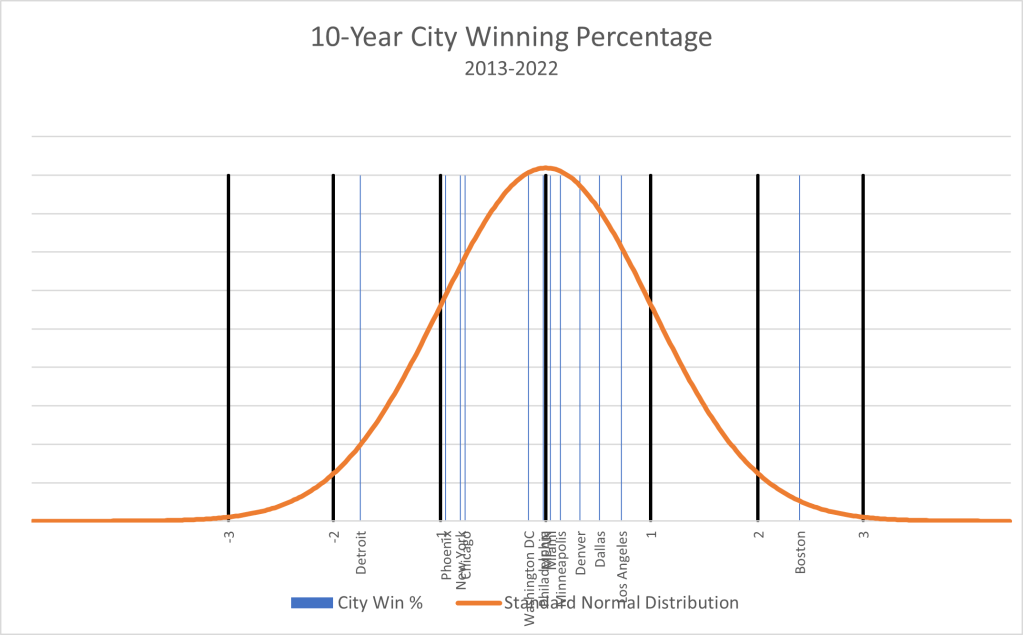
Table A provides the average winning percentage for each of the 4-sport cities over the past five years (2018-2022) and ten years (2013-2022). The cities are listed in descending order according to their winning percentage. So, in terms of fan misery, the further down the list equates to higher levels of misery. Also, Chart A graphs the normal curve for the ten-year winning percentage of the thirteen four-sport cities.

4-Sport City10-year Average Winning %Standard Deviation4-Sport City5-year Average Winning %Standard Deviation
Boston.6142.40Boston.6071.73
Los Angeles.5410.71Philadelphia.5460.70
Dallas.5320.50Los Angeles.5390.59
Denver.5240.33Minneapolis.5320.45
San Francisco.5240.33Denver.5320.45
Minneapolis.5160.15Dallas.5290.39
Miami.5120.05Miami.5230.29
Philadelphia.509-0.03San Francisco.5200.25
Washington DC.503-0.16New York.485-0.35
Chicago.477-0.77Washington DC.468-0.64
New York.475-0.81Chicago.468-0.64
Phoenix.469-0.94Phoenix.459-0.79
Detroit.434-1.75Detroit.364-2.43

Table A: Average winning % over the past five and ten years

Chart A: Normal curve depicting city winning % over the past five years1

As is our practice, we like to have the data tell the story. First, Boston has maintained an incredible winning percentage over a ten-year horizon. In fact, the difference between Boston and the second highest city (Los Angeles) is higher over the ten-year horizon than the difference between Boston and the second highest city (Philadelphia) over the five-year time period. This is quite unexpected as we discussed in a previous article that as you increase the number of observations, the outliers tend to move closer to the mean. Also, as good as Boston was from 2018-2022, relative to the rest of the 4-sport cities, Boston was actually better during the first five-years of this ten-year period.2

Second, and in keeping with the comments made in the previous paragraph, the daily “non-misery” of Boston fans is hard to overlook. In precisely the same way we argued that Detroit’s daily five-year misery was not even close to any other city, Boston’s ten-year non-misery is not even close to any other city. Chart A provides the best evidence to back this claim as Boston is the only city whose winning percentage is over +1 standard deviations from the mean; in fact, it is +2.4 standard deviations from the mean. To put this in perspective, we would expect a number to be this far from the mean approximately 0.8% of the time. Perhaps unprecedented, but additional historical data would have to be obtained to validate this claim.

Third, Chicago, New York, and Phoenix fans have had a particularly dismal decade in terms of daily city misery. These fans can certainly empathize with Detroit fans. Perhaps the recent rise in fortunes for the Cubs and Diamondbacks during the 2023 MLB season will alleviate some of the misery for Chicago and Phoenix, Unfortunately for New York fans, the Mets and Yankees have been major disappointments based on pre-season expectations.

Finally, Table B adds the ten-year winning percentage for the 3-sport cities. As we discussed in a previous article, we would expect the 3-sport cities to have higher variability relative to those of the 4-sport cities. Therefore, we would expect to see higher highs and lower lows for the 3-sport cities. We see this on the high end with 3-sport Pittsburgh, Toronto, and Milwaukee well above 4-sport Los Angeles. But this also provides yet further evidence of Boston’s extraordinary ten-year run as their winning percentage is still well above that of the best 3-sport city.

Table B also provides insight into the misery claims of Cleveland fans as being the most severe. The data provides ample evidence of misery. It is postulated that other components of the fan misery index will provide additional evidence for Cleveland’s self-proclaimed misery. Branching into other components will be the content of the next several posts. Stay tuned.

4-Sport CityAverage Winning %3-Sport CityAverage Winning %
Boston.614  
  Pittsburgh.574
  Toronto.567
  Milwaukee.565
Los Angeles.541  
  Tampa Bay.541
Dallas.532  
Denver.524  
San Francisco.524  
Minneapolis.516  
Miami.512  
  Charlotte.511
Philadelphia.509  
Washington DC.503  
  Houston.494
  Atlanta.483
Chicago.477  
New York.475  
Phoenix.469  
  Cleveland.464
Detroit.434  

Table B: Winning % over the past ten years for 4-sport cities and 3-sport cities.

_____________________________________________________________________________

1 San Francisco is not shown in this chart since it has the same ten-year winning % as that of Denver.

2 In order of magnitude, the top three teams that were better during the first five-years of this ten-year period were Detroit, Boston, and Washington DC. The top three teams that were better during the most recent five-years of this ten-year period were Philadelphia, New York, and Minneapolis.